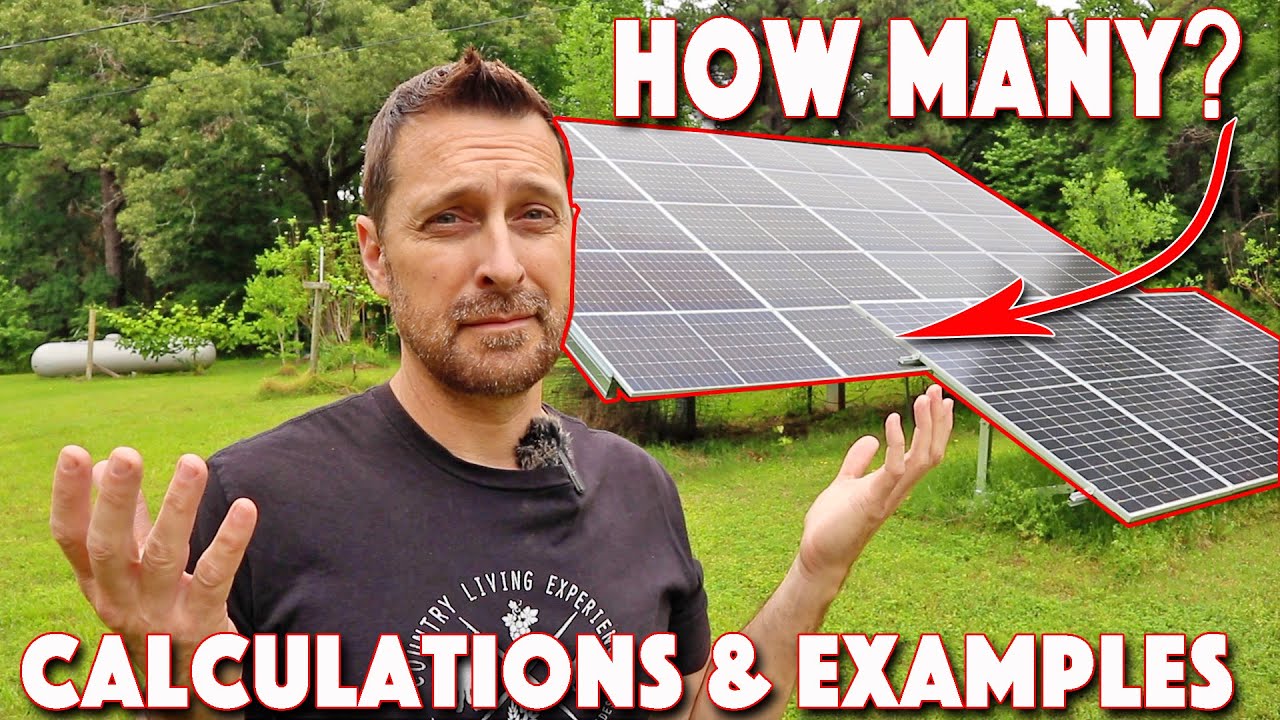
How to Size Your Off-Grid Solar System
How to Size Your Off-Grid Solar System
Venturing off-grid offers unparalleled freedom, but ensuring a reliable power supply is paramount. The cornerstone of any successful off-grid setup is a properly sized solar system. As your go-to experts at Off-Grid Tech Guide, we’re here to walk you through the essential steps to design a system that meets your unique needs, from a small weekend cabin to a full-time homestead.
Step 1: Conduct Your Energy Audit – Understanding Your Power Needs
Before you buy a single solar panel or battery, you need to know exactly how much power you consume. This "energy audit" is the most critical step in sizing your system, as it dictates everything else. Grab a pen and paper, or fire up a spreadsheet, and list every appliance you plan to power.
For each item, note its wattage (W) and how many hours per day you expect to use it. Many appliances have their wattage listed on a sticker or in the manual. Multiply the wattage by daily usage hours to get its daily Watt-hour (Wh) consumption. Summing these up gives you your total daily energy requirement in Wh.
- Example:
- LED Lights (10W each, 4 lights, 5 hours/day): 10W * 4 * 5h = 200 Wh/day
- Laptop (60W, 4 hours/day): 60W * 4h = 240 Wh/day
- Mini-Fridge (50W, runs 12 hours/day cycling): 50W * 12h = 600 Wh/day
- Phone Charger (10W, 2 hours/day): 10W * 2h = 20 Wh/day
- Total Daily Energy: 1060 Wh/day
Step 2: Calculate Your Battery Bank Capacity
Your battery bank is the heart of your off-grid system, storing the solar energy for when the sun isn't shining. To size it correctly, take your total daily energy requirement (from Step 1) and multiply it by the number of "autonomy days" you want. Autonomy days represent how long your system can run without any solar input, crucial for cloudy weather or winter months.
Modern `LiFePO4` (Lithium Iron Phosphate) batteries are highly recommended for their long lifespan, high cycle counts, and 100% usable capacity, unlike lead-acid batteries. For our 1060 Wh/day example, aiming for 2-3 autonomy days is a good starting point for many systems. Let's assume 2 days: 1060 Wh/day * 2 days = 2120 Wh.
For smaller, portable needs, an all-in-one power station like the EcoFlow DELTA 2 Max (2048 Wh, $999) or the Jackery Explorer 2000 Plus (2042 Wh, $1,699) could cover this capacity. For larger, more permanent installations, consider dedicated `LiFePO4` batteries. A Renogy 12V 200Ah LiFePO4 Battery provides 2560 Wh (200Ah * 12V * 1.0 = 2400Wh usable, $399), or two LiTime 12V 100Ah LiFePO4 Batteries (1280 Wh each for $199) could be wired in parallel for 2560 Wh total. For serious capacity and performance, the Battle Born Batteries 12V 270Ah GC3 LiFePO4 offers 3456 Wh ($895) with integrated cold weather protection.
Step 3: Determine Your Solar Panel Array Size
Now that you know your battery capacity, you need enough solar panels to recharge it. The key factor here is "peak sun hours" – the average number of hours per day your location receives direct sunlight. This varies significantly by geography and season. You can find this data online for your specific area; a common average for many parts of the US is 4-5 peak sun hours.
To calculate the minimum solar panel wattage (Wp) needed: (Total Daily Energy Wh / Peak Sun Hours) * 1.25 (to account for system losses, inefficiency, and less-than-ideal conditions). Using our 1060 Wh/day example with 4 peak sun hours: (1060 Wh / 4h) * 1.25 = 331.25 Wp. This means you'd ideally want at least 350-400 Watts of solar panels.
You can achieve this with several smaller panels or fewer larger ones. For portability, consider panels like the EcoFlow 220W Portable Solar Panel ($249) with its bifacial design or two Jackery SolarSaga 100W panels ($179 each). For more permanent setups, a single Renogy 400W 12V Monocrystalline Panel ($249) or multiple Bluetti PV200 panels ($229 each) would work well, ensuring consistent output and durability.
Step 4: Select Your Inverter
The inverter converts the DC power from your batteries into usable AC power for most household appliances. Sizing your inverter correctly means matching it to your appliances' peak power draw. Look at the highest wattage appliance you plan to run, and then consider any other devices you might operate simultaneously.
For instance, if your highest single appliance is a microwave at 1000W, and you might also run a coffee maker (800W) simultaneously, you'd need an inverter capable of handling at least 1800W continuous output, plus a surge capacity for start-up spikes. Many portable power stations have integrated inverters, like the EcoFlow DELTA 2 (1800W output, $599) or the Anker SOLIX C1000 (1800W output, $699). For larger, whole-home power, the EcoFlow DELTA Pro Ultra boasts an impressive 7200W continuous output ($5,799), while the Bluetti AC300 offers 3000W output ($1,999) with expandable battery capacity.
Ensure your chosen inverter can handle both the continuous wattage and the momentary "surge" wattage of your largest motor-driven appliances (like refrigerators or power tools). If building a component-based system, you'll also need a separate charge controller to manage power flow from your solar panels to your batteries; many `Portable Power Stations` integrate this seamlessly.
Step 5: Putting It All Together – System Examples and Considerations
Sizing your off-grid solar system is a balancing act between your energy needs, budget, and desired redundancy. Start with a conservative estimate of your power usage and allow for future expansion if possible. Always consider adding a buffer to your calculations to account for unforeseen demands or suboptimal weather.
- For a basic, portable setup (camping, small emergencies):
- Daily Needs: ~200-500 Wh
- Recommended: EcoFlow RIVER 2 Max (512 Wh, $299) or Jackery Explorer 500 (518 Wh, $299) paired with an EcoFlow 110W Portable Solar Panel ($149).
- For a weekend cabin or RV:
- Daily Needs: ~1000-2000 Wh
- Recommended: EcoFlow DELTA 2 Max (2048 Wh, $999) or Bluetti AC200MAX (2048 Wh, $1,199) with two Bluetti PV200 panels ($229 each).
- For a full-time tiny home or robust backup:
- Daily Needs: ~3000 Wh+
- Recommended: EcoFlow DELTA Pro (3600 Wh, $2,499) or Bluetti EP500 Pro (5100 Wh, $3,499) with multiple Renogy 400W 12V Monocrystalline Panels ($249 each) or larger portable panels like the Bluetti PV350 ($399).
By following these steps, you can confidently size an off-grid solar system that provides reliable, sustainable power for your lifestyle. Remember to factor in installation costs and potential maintenance when budgeting. Happy off-grid living!